
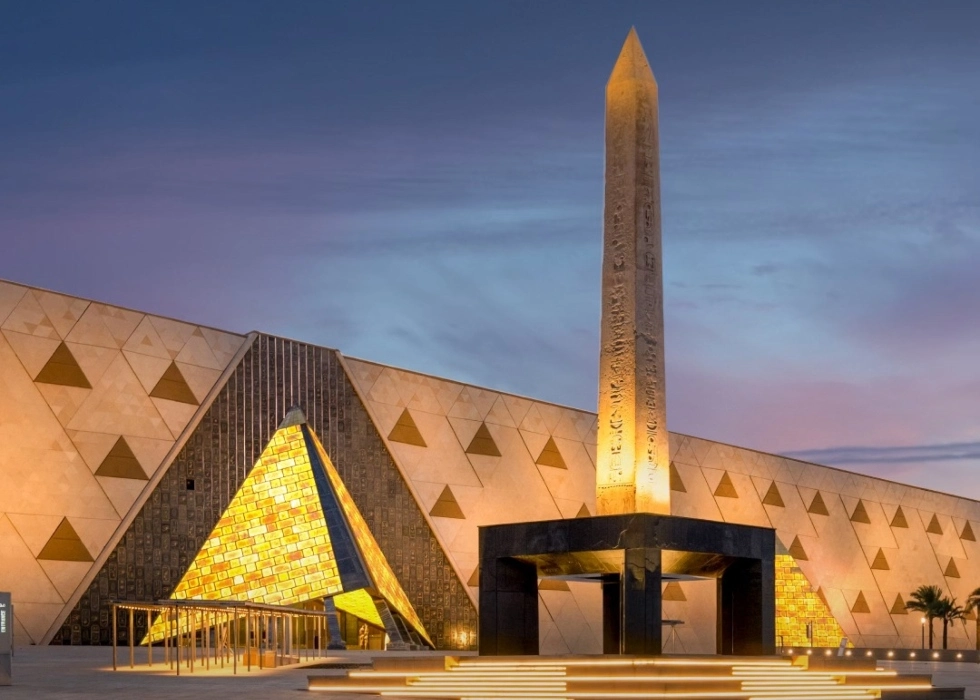
The world turned its eyes to Egypt to witness the fulfillment of a dream more than two decades in the making. After a grand opening, the Grand Egyptian Museum (GEM) officially opened its doors to visitors on November 4.
Spanning an area equivalent to about 60–70 football fields, it is the largest museum in the world dedicated to the history of a single civilization. Just a few days after its official opening, it reached its daily capacity (around 50,000 visitors), and ticket sales for the day were suspended.
But what makes this new home for Egypt’s treasures stand out, and why might its opening strengthen Egypt’s case for reclaiming its iconic artifacts from foreign collections?
GEM symbolizes the way modern museums are transforming the presentation of cultural heritage, turning it into a multisensory experience.
From its architecture to the stories of individual artifacts, this project shows how the past can connect with the future without losing its authenticity.

Photo by Karim Osama (Egyptology)
The landscape as part of the story
The museum is located right next to the Pyramids of Giza, one of the most iconic sites of human civilization.
The architectural design of the building, perfectly aligned with the pyramids, leaves no detail to chance. The setting enhances the sense of continuity between antiquity and the modern world.
In many modern museums, the location itself also plays an active role in the visitor experience, but the Grand Egyptian Museum takes this to another level: through its vast windows overlooking the Giza Plateau, the pyramids become the museum’s greatest exhibit.

Photo by Karim Osama (Egyptology)
The artifacts tell their own stories to the visitor.
The goal of modern museums is not only to preserve and display artifacts but to arrange them in a way that tells a story.
At the GEM, this is achieved through clearly structured exhibitions: the halls take visitors on a journey through millennia, divided into thematic zones: kingdom, religion, and society.
For museum professionals, it’s an example of how chronology and theme can be combined without losing clarity. For visitors, it’s a way to understand where they stand in time and why each display matters.

Photo: https://hannahpethen.com/
Technology as a bridge, not a replacement
The Grand Egyptian Museum impresses with its vast infrastructure, interactive displays, and halls for digital reconstructions. But its true strength lies in balance. Technology doesn’t overshadow the artifacts: it enhances them.
This is a valuable lesson for all modern museums: digitalization should not replace the human element but complement it. Its role is to provide accessibility, understanding, and new perspectives.
When a visitor leaves the hall feeling closer to history, the technology has fulfilled its purpose.
The story of history as part of the experience
One of the most impressive features of the GEM is its vast conservation center. There, the preservation of cultural heritage becomes an open process. Visitors can observe the work of restorers through special glass walls: a rare but powerful approach.
Modern museums increasingly strive to involve the public in the “life” of the exhibit. This fosters respect, trust, and awareness among visitors. They see that cultural heritage is not just about valuable objects but also about the effort invested in preserving them.

Photo by CNN
The museum as a space for encounters between people and stories
One of the most valuable achievements of the Grand Egyptian Museum is its ability to present the grand history of Ancient Egypt through the lens of human experience. The entire Tutankhamun collection, for instance, occupies a separate gallery, but its arrangement is not meant merely to impress with the brilliance of gold or the beauty of craftsmanship. Instead, it traces the life of a person who was not only a ruler but also a son, a student, and a devotee. The gold reflects the rhythm of his life and the spirit of his beliefs, not only the power he held
This is one of the core principles of modern museums: to uncover the human stories behind the artifacts: who created them, why, and what they meant to express. Through that, visitors realize that even though centuries or millennia have passed, we haven’t changed all that much. And that’s why these stories move us so deeply.
A good curator today doesn’t think only in terms of “periods” or “cultures,” but in terms of experiences. The question is not just “Which era is this from?”, but also but “what might a person feel when standing before it?”
When a museum builds an emotional bridge between past and present, knowledge becomes a personal experiencе, something the visitor carries away.
The modern museum has transformed its role: from a warehouse of objects into a meeting place for people and stories. The answer to the question “how do we help the visitor hear the voice of the artifact?” lies in the human story woven into the scientific context. When we find a way to bring science and emotion together in one space, heritage comes alive and stays with the visitor.

The museum as cultural diplomacy
The Grand Egyptian Museum is also a diplomatic project a bridge between Egypt and the world. It promotes cultural tourism, the exchange of ideas, and a global dialogue on cultural heritage.
This too is a hallmark of the modern museum: beyond being a guardian of artifacts, it has become an active participant in public discourse and the shaping of cultural identity.
Lessons for the future
From the Grand Egyptian Museum, we can draw several clear lessons for museum practice today:
- The landscape is part of the story.
- The story itself can guide the visitor.
- Technology is a mediator—it shouldn’t replace the human factor but help us understand it better.
- Transparency builds trust.
- Human stories bring the past to life.


Details of Tutankhamun’s innermost gold coffin, weighing 110 kilogramsdepicting the young king as Osiris, embraced by the goddesses Isis and Nephthys.
Photos: Karim Osama (Egyptology)
Why this matters to us
Yatrus Foundation shares the same philosophy. Our mission is to help preserve and present cultural heritage through modern methods and digital technologies.
We believe that preserving the past holds true value for modern people only when it’s presented in a way that is accessible, interactive, and relevant to the present.
The Grand Egyptian Museum reminds us that respect for history and innovation are not opposites. Combined, they help preserve human memory by making it understandable for the future.